
Turlock City Directories by Collection
The surviving Turlock historical-directory picture is a set of distinct collections, not a proven run from one publisher. The strongest named local source is the CSU Stanislaus Special Collections archive, while the National Archives confirms one regional directory inventory. A shelf search can add volumes, but the public pages inspected do not establish an exhaustive publisher list, a continuous year sequence, or a fixed last printed year.
| Collection | Years | Where Held | Access/use |
|---|---|---|---|
| Modesto directory including Stanislaus County and Turlock | 1928-1933 | NARA circa-1930 directory inventory | Authoritative run confirmation; confirm the item-level access route |
| Stanislaus County and Cities historical records | 1854 to roughly the 1980s | CSU Stanislaus Special Collections | Open for research; request boxes and folders |
| Turlock maps | 1903-1972 | CSU Stanislaus Special Collections | Open for research; align streets, lots, and boundaries |
| Turlock assessment lists and rolls | 1908-1954 | CSU Stanislaus Special Collections | Named taxpayer and property evidence |
| Turlock personal-property lists | 1934-35, 1939-40, 1954-55 | CSU Stanislaus Special Collections | Household and business property clues |
| Turlock local census | 1913 | CSU Stanislaus Special Collections | Household and name evidence between federal schedules |
| Turlock Sanborn maps | 1888, 1891, 1896, 1905, 1907, 1910, 1912, 1922, 1945 updated | Library of Congress and library databases | Building use and address context, not occupants |
| Printed, telephone, and reverse directories | Exact local run not established | Turlock Library and genealogy institutions | Ask reference staff to search catalog variants |
The table separates a verified regional directory run from useful directory substitutes. The CSU collection also contains Stanislaus marriage licenses from 1875-1907 and Great Register cancellations from 1878. Those records can anchor a person or family, but neither is a local directory. A Turlock city directory shelf may fill a gap, yet no inspected source names a complete publisher sequence. Treat a missing year as a research gap until a librarian or archivist confirms it.
No verified continuous printed-directory run, publisher list, actual Turlock entry image, or abbreviation key was located in the inspected sources.
Note: A directory year in a catalog is evidence of a holding, while a scanned page is evidence of the exact fields and abbreviations used.
Where Turlock City Directories Live
The Turlock branch of the Stanislaus County Library is the practical first stop for a local directory search close to town. Its public resources page offers genealogy and local research paths, yet the pages inspected do not publish a complete shelf-level run. Ask for a reference search rather than assuming that a catalog title proves every issue is present. Request variants that reflect how regional books were often named, including Turlock, Modesto and Turlock, and Stanislaus County.
The branch can also point a researcher toward telephone books, reverse directories, newspapers, yearbooks, and obituary indexes. Current library hours and access rules should be checked before a visit. A directory may be in a reference area, on microfilm, in a genealogy database, or represented only by a catalog record. Each route changes what can be copied and whether a staff-assisted search is needed.
For deeper local history, contact CSU Stanislaus Special Collections at the University Library, One University Circle, Turlock, CA 95382, or mweppler@csustan.edu. The 75-linear-foot county and cities collection is open for research. Give staff the family name, likely years, street, and collection type, then ask which boxes or folders may be requested and what copying rules apply.
These Stanislaus County Library research resources are the right starting point for asking about local history databases and reference help.
The library gateway does not prove a continuous local run, but it gives a researcher a way to test catalog names, databases, and staff-held knowledge.
The Turlock Library location and hours page should be checked before using a reading room or reference desk.
Hours are an access detail, not proof of shelf content. Ask in advance for the exact local directory, telephone, or criss-cross title needed.
The Verified Turlock Directory Run
The National Archives circa-1930 directory inventory is the clearest publisher-neutral confirmation available for Turlock. It lists a Modesto directory that includes Stanislaus County and Turlock for 1928-1933. That span is the only Turlock city directory run directly confirmed in the supplied research. It is also the clearest verified city directory span for a household search. The inventory does not state a publisher in the research record, so a page should not attach a company name or imply that every year has been scanned.
The National Archives directory inventory is useful because it confirms a regional title and a bounded span. It does not settle where a researcher can read each volume today. Confirm whether the needed issue is held locally, available through a library database, or accessible by an archive request.
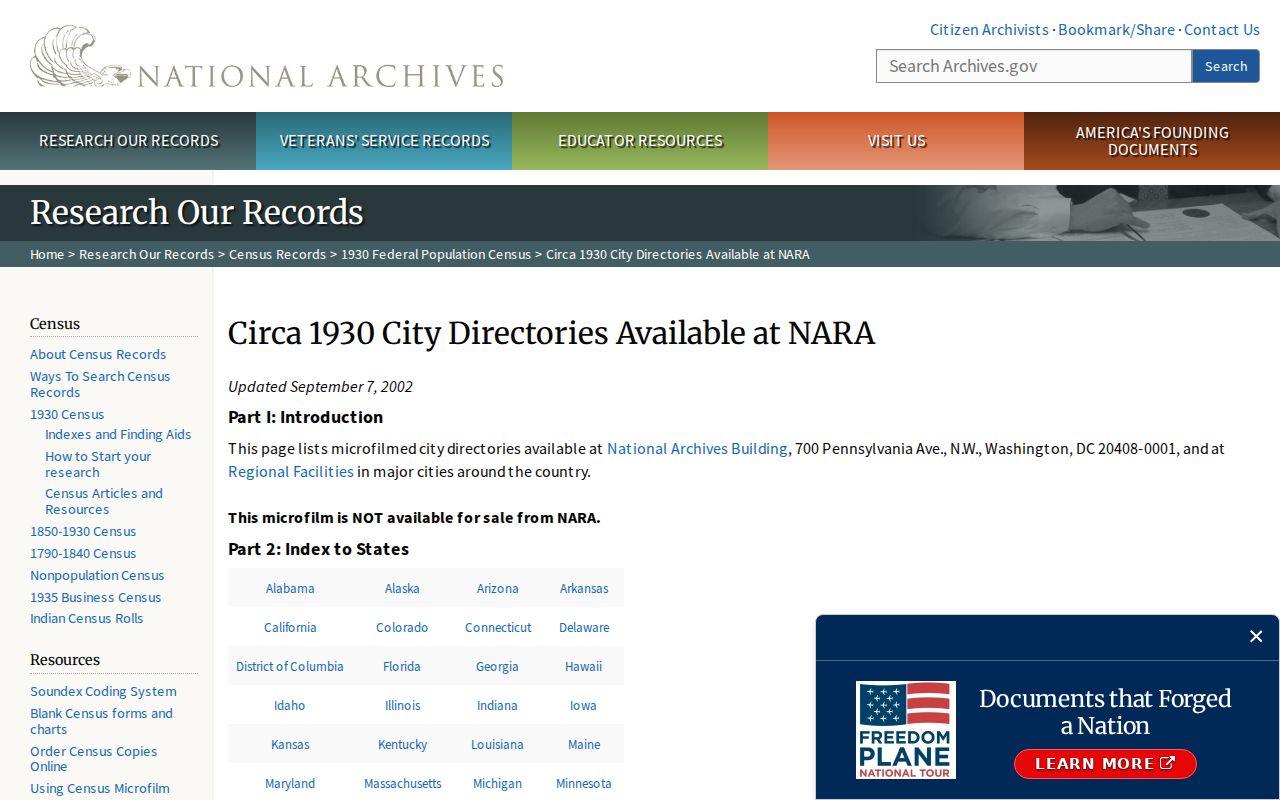
The NARA image supports the 1928-1933 inventory claim. It is not an inspected Turlock entry page, so local abbreviations and field order remain unverified.
This is a useful comparison: a source can prove that a regional directory run existed while leaving the physical access path and page format unresolved. That distinction protects a family-history search from false precision. Record the exact title and year first, then ask the repository whether the entry can be viewed.
Reading Turlock City Directory Entries
No official open source inspected for Turlock supplied an actual city directory page or a local abbreviation key. The fields below are therefore an inspection checklist, not a claim that every local volume used every mark. Photograph or transcribe the key at the front or back of a volume before interpreting a short letter beside a name.
| Name | Usually the listed person, with a given name or initial; check spelling and compound surnames. |
|---|---|
| Spouse | Some entries put a spouse in parentheses or use a widow notation; verify the local volume. |
| Occupation | A historical work description or affiliation that can help separate namesakes. |
| Residence | House number and street, with a separate business address when one is listed. |
| Property-status mark | A symbol or abbreviation may distinguish a listed property relationship, but the Turlock convention is not verified. |
| Community clue | A school, club, church, or civic affiliation may help separate namesakes; verify what the local volume prints. |
- Criss-cross directory
- A reverse section arranged by street or address so a known location can lead to a listed name.
- Householder index
- A name-oriented entry point centered on the person treated as the household lead; it may omit other household members.
- Abbreviation key
- The volume's explanation of short marks for residence, relationship, occupation, or property status. Turlock's key remains a research gap.
- Index versus image
- An index points to a title, name, or locator; an image shows the page that must be read and cited.
An entry can suggest a family link without proving it. Compare the street, nearby names, spouse notation, and year. Then use the 1913 local census, an assessment roll, or a newspaper to test the lead. A directory absence can reflect a move, death, unlisted person, missing volume, rural delivery, or a spelling change.
Trace One Turlock Household
A household trail needs a fixed starting point and a record log. Choose the clearest known name, year, or street, then keep the source role visible as the search moves from a city directory volume to a census schedule. The 1913 Turlock census is a useful local bridge, while federal schedules provide wider decade markers. Neither source should be used to fill a gap by guesswork.
- Choose one known directory year and copy the name, address, spouse notation, occupation, and any property-status mark exactly.
- Check the nearest earlier and later volumes, if held, and note the first appearance, last appearance, spelling change, and every address change.
- Pair the entry with the 1913 local census or the closest public federal census, recording household relationships and the stated address.
- Compare the result with Turlock assessment rolls, personal-property lists, a map, marriage license, or newspaper item that fits the same period.
- Use an obituary, probate notice, yearbook, or community archive to test a move, death, marriage, or family connection.
- Write the conclusion with separate labels for listed householder, census resident, taxpayer, owner, and supporting clue.
Disappearing from a volume does not have one meaning. The person may have moved, died, become unlisted, changed a surname, or fallen into a publication gap. A continuous story comes from several dated sources, not from treating a single directory line as a complete household record.
Reverse Turlock City Directories
Reverse or criss-cross volumes are valuable when the address is known but the name is not. A house-number sequence can turn a street clue into a listed householder, yet the exact Turlock reverse-directory run has not been established. Do not promise that every parcel, multi-unit address, rural route, or household appears. Ask the library whether a street-order volume exists for the year in question and whether its coverage is citywide.
Use the address as a fixed point, then record the exact spelling of the street, directional prefix, house number, and any unit mark. A map may show that an old street line or block changed. The CSU Turlock map series from 1903-1972 is especially useful for reconciling the physical place before you decide that a missing reverse entry means a person was absent.
Catalog requests work better when they include several plausible titles. Ask the Turlock Library reference desk to check:
- Turlock directory and Turlock telephone directory
- Modesto and Turlock directory
- Stanislaus County directory
- Criss-cross or reverse directory
- Yearbooks, obituary indexes, and local newspapers for the same address
These terms are search prompts, not a claim that each title exists. Ask which years are actually held, whether the item is on shelf or film, and whether copying is allowed.
Note: A reverse listing usually identifies a listed householder, not every person who shared the address during that year.
Turlock Records Between Census Years
Turlock's local evidence is unusually helpful between federal census dates. CSU Special Collections holds a 1913 Turlock census, which can bridge the 1910 and 1920 federal schedules. The same parent collection includes assessment rolls from 1908-1954, personal-property lists from 1934-35, 1939-40, and 1954-55, marriage licenses from 1875-1907, and Great Register cancellations from 1878. Each source answers a different question.
The 1913 census is a household clue. An assessment roll is stronger for a taxpayer and property connection. A personal-property list can show a named person or business with taxable property. A marriage license links an event and couple. A Great Register cancellation can document historic elector status. None should be relabeled as a complete resident directory.
| 1854 to roughly the 1980s | CSU county and cities collection spans the local record environment. |
|---|---|
| 1875-1907 | Stanislaus marriage licenses support couple and event research. |
| 1908 | Turlock assessment rolls begin in the identified collection; the first free city library also opened. |
| 1913 | Local census supplies a household snapshot between federal schedules. |
| 1928-1933 | NARA confirms the Modesto regional directory that includes Stanislaus County and Turlock. |
| 1934-35, 1939-40, 1954-55 | Personal-property lists add named property and business context. |
The timeline is a comparison tool. It does not turn a property record into proof of physical presence. Keep separate notes for owner, taxpayer, listed householder, census resident, and event participant.
Assessment Rolls as Turlock Directories
The 1908-1954 Turlock assessment rolls are one of the strongest local substitutes for a missing printed directory. They can connect a taxpayer to property in a year when no volume has been verified. Personal-property lists from 1934-35, 1939-40, and 1954-55 broaden the trail beyond land. These are archival records of assessed property, not lists of every resident.
Read the roll beside a directory, deed, or census rather than alone. A person may own a parcel without living there, and a household member may live there without appearing as the taxpayer. A changing name can reflect a sale, estate, business, spelling difference, or an indexing choice. The record's role and date must stay visible in the research notes.
CSU's local archive is especially valuable because the 75-linear-foot county and cities collection preserved government material saved from disposition, including Turlock tax and assessment evidence. Contact the University Library at One University Circle with a narrow request for the roll year, surname, street, or parcel context. Staff can explain which box or folder is relevant and whether a copy can be made.
Note: Assessment evidence can fill a directory gap, but it cannot by itself establish that a named taxpayer occupied the Turlock property.
Turlock City Directory Maps
Addresses drift when streets, boundaries, lots, and building footprints change. CSU Special Collections holds Turlock maps dated 1903-1972, making that series a bridge between a directory line and the place it describes. Use a map to test whether a street name, block, or house number lines up before joining two entries across years.
Sanborn editions add a second kind of context: Turlock sheets are confirmed for 1888, 1891, 1896, 1905, 1907, 1910, 1912, 1922, and a 1945 updated edition. Sanborn maps show buildings, materials, uses, street names, property lines, and house or block numbers. They do not identify occupants. A mapped building can support physical continuity, not a claim about who lived there.
The CSU Turlock map collection record provides the dated map-series anchor for this check.
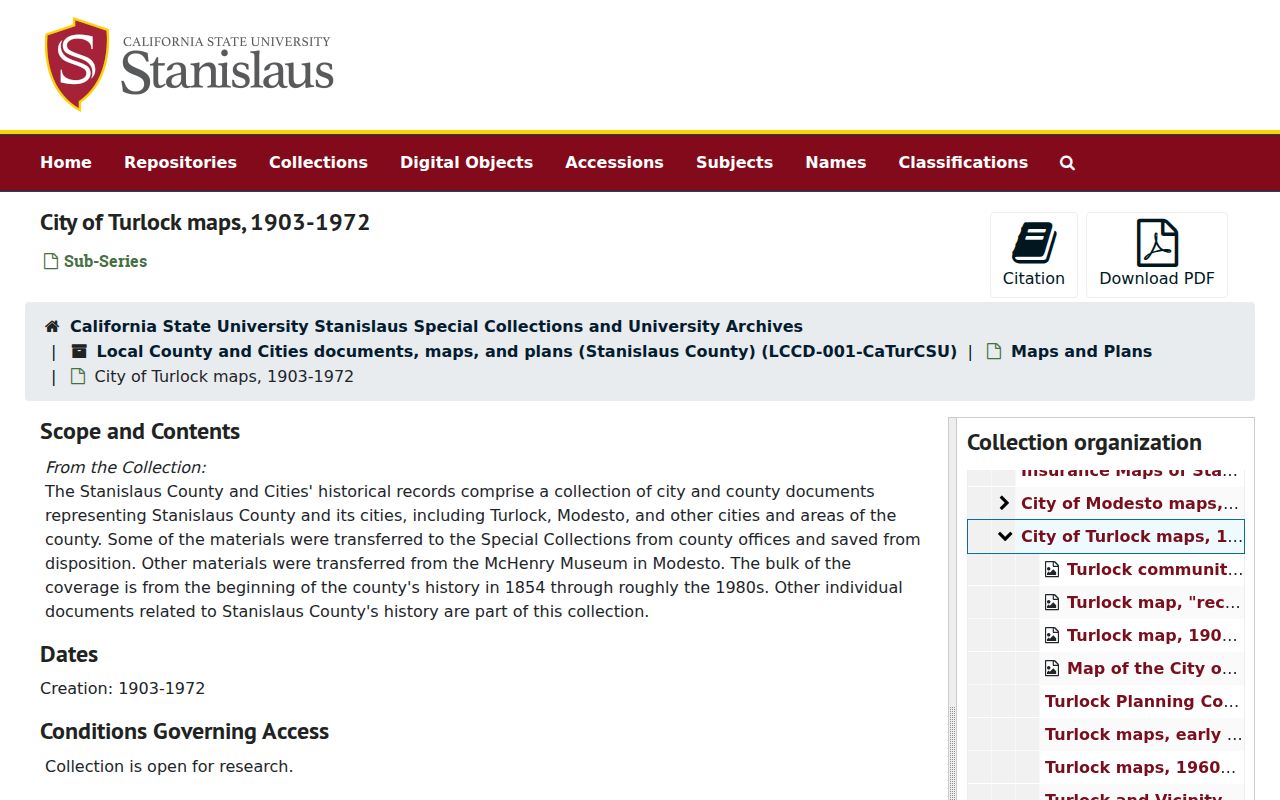
The linked archival description helps place an old street in the right collection, while the map itself must be read with the directory or roll for the same period.
For present-day address work, the Turlock streets and address records page handles the modern parcel trail. Historical directories should remain focused on the names, years, and formats that the older shelves can actually support.
Turlock's Newspaper Directory Clues
Newspapers can explain a directory appearance or disappearance through a marriage notice, obituary, community event, business item, or move. CSU Special Collections reports that the full Turlock Journal and predecessor archive is on microfilm in its periodicals stacks. The current print series is described as 2009-2026. Digitization of the Turlock Journal and Turlock Tribune from 1904-2008 was coordinated through the California Digital Newspaper Collection, Newspapers.com, the Turlock Historical Society, and Turlock Public Library.
Remote access must be confirmed before promising a searchable run. A database may expose an index while a microfilm reel holds the readable page. Search by name and street, then record the newspaper date, page, and item type. An obituary can connect relatives and former addresses, but survivor details should be handled with care.
Turlock's community history also matters when spelling varies. Portuguese and Azorean, Assyrian, Japanese, and other immigrant histories appear in local research contexts. Test compound surnames, transliterations, married names, and alternate initials. Do not infer a person's background from a surname; use an archival source that actually states the connection.
When a historical name needs a current record check, the Turlock resident lookup page keeps the task centered on dates, roles, and independent sources rather than treating one directory line as proof.
Turlock's Municipal Record Trail
City records can add context when a directory points to a public institution, a project, or a named civic role. Turlock City Hall is at 156 S. Broadway. The City Clerk maintains ordinances and resolutions, City Council and related proceedings, board and commission rosters, the Municipal Code, local election records, campaign disclosures, Statements of Economic Interests, claims, and certified copies.
A focused California Public Records Act request can ask for an existing, identifiable record by address, date range, or named series. It cannot require the City to create a new resident directory or answer a broad research question. Building and Planning files may identify an applicant, owner, contractor, scope, permit number, and work dates, but a project record is not proof of residence. Keep this municipal layer beside, not inside, the directory entry.
The City of Turlock government and City Clerk gateway shows where municipal records begin.
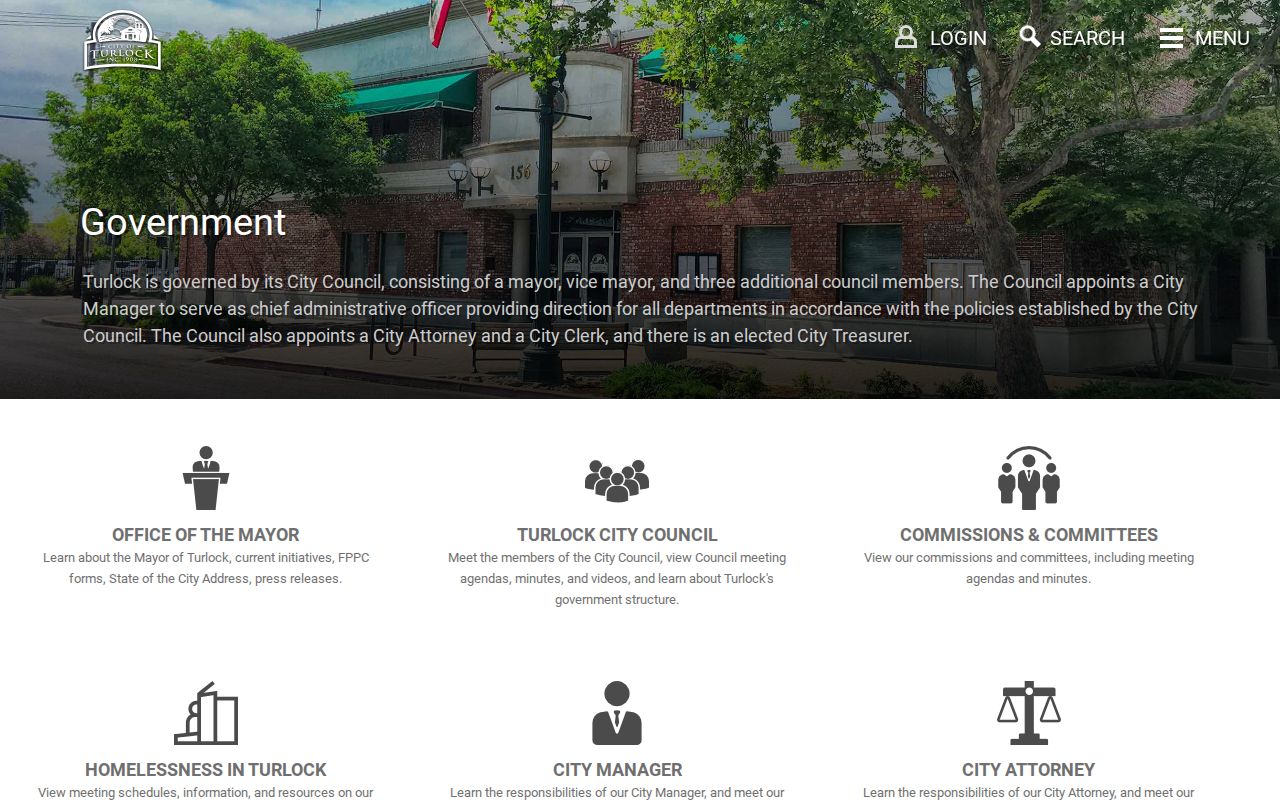
The municipal gateway is useful for locating a custodian and record series. It does not replace a library search for a printed directory or a CSU archive request for older local collections.
The first free Turlock city library opened in 1908, the same year the identified assessment-roll sequence begins. That coincidence helps explain why later local research has both a civic library channel and a tax-record channel, while neither should be mistaken for a complete roster.