
Turlock Previous Residents by Era
A useful address history begins by matching the question to the record's era and purpose. RecorderWorks reaches back by name in its advertised index, but image access has a different depth. CSU Stanislaus Special Collections supplies local tax, map, and census evidence, while federal census schedules and library holdings add the household layer. The table keeps those channels separate so a deed is not mistaken for proof that someone lived at the property.
| Source | Years It Covers | Where Held | What It Shows |
|---|---|---|---|
| RecorderWorks name index | 1850-present advertised | Stanislaus County Clerk-Recorder online | Indexed parties, document types, dates, and locators |
| Electronic recorded-document images | Generally 1978-present | Clerk-Recorder computers and online results as available | Recorded instruments and legal descriptions |
| Grantor and grantee counter index | 1920-1988 | Clerk-Recorder counter in Modesto | Historic party names and document locators |
| Recorder microfilm and fiche | Back to 1853 | Clerk-Recorder | Older official-record images reached through locators |
| Turlock assessment rolls | 1908-1954 | CSU Stanislaus Special Collections | Taxpayer and property evidence |
| Turlock maps | 1903-1972 | CSU Stanislaus Special Collections | Street, parcel, and boundary continuity |
| Turlock local census | 1913 | CSU Stanislaus Special Collections | Local household and name evidence |
| Federal population census | Public through 1950 | NARA and library genealogy databases | Household members, relationships, address, and occupation |
| Permits and planning files | Online cutoff not located | City of Turlock Building and Planning | Address or APN project participants and work dates |
Current city records, a local library reference search, and CSU archival requests fill gaps that an online index cannot. Printed city directory years are not established as a continuous local run, so a missing volume must be treated as unknown. The source date, access route, and kind of evidence belong in every note about the previous residents trail.
Note: The same address can appear in a deed, roll, directory, and census while each record names a different kind of connection.
Turlock Property to APN
Begin with the present parcel, not a guessed surname. The Stanislaus County Assessor and county GIS can help normalize a street address, identify the assessor parcel number, and separate the physical situs from the tax-mailing address. The APN is an administrative parcel key. The legal description, subdivision reference, and parcel boundary are stronger anchors when an older deed uses a street name that no longer matches current usage.
The county's free public assessor inquiry requires a known APN. Do not describe it as an unrestricted name search. Use the Stanislaus County Assessor entry point and the county GIS applications to locate the parcel, then write down the owner of record, situs, mailing destination, legal description, and any document number shown in the available record.
GIS adds the shape and surrounding context. Search the address or APN, select the parcel polygon, and compare adjoining parcels. If the mailing address differs from the situs, that supports only an absentee-mailing possibility. It does not identify the people who occupied the property. A parcel card likewise does not reliably list family members or every household member. The first previous residents clue is a parcel anchor, not a guessed name.
Note: An APN anchors the address history, while the legal description carries the older property identity.
Turlock Deed Chain Backward
Once the parcel and current owner are anchored, walk the chain of title backward through the Stanislaus County Clerk-Recorder. RecorderWorks is name-centered, so the address must first be translated into an owner name and legal description. Search the current owner as a grantee for the acquisition deed, confirm the legal description, then take the seller backward as the next likely grantee. The chain is an ownership history. It is not a list of past occupants.
- Capture the current APN, situs, owner, mailing address, and legal description from the assessor or GIS record.
- Search the owner in RecorderWorks using the name tab, a bounded date range, and a partial match only when spelling requires it.
- Open the likely acquisition document and compare its legal description or APN with the parcel anchor.
- Record the seller or transferor, then search that party as an earlier grantee rather than assuming the same street address will work.
- Repeat backward, separating deeds from trust deeds, reconveyances, releases, liens, and judgments.
- When the online result ends, carry the book, page, or document locator to the counter index, film, or fiche route.
- Grantor and grantee
- On a conveyance, the grantor transfers an interest and the grantee receives it. Roles can differ on a trust deed, lien, or release, so read the instrument type.
- Chain of title
- The linked sequence of recorded transfers and related instruments used to show how an ownership interest moved.
- Legal description
- The lot, block, subdivision, or other formal land description that identifies the parcel beyond a changing street label.
- Criss-cross directory
- A reverse directory arranged by street or address, used to test listed householders after the ownership trail is built.
RecorderWorks search results may show document number, recording date, document type, party names and roles, book or page locator, and linked party-name navigation. An index hit is not the deed image. Obtain the document when the question depends on the exact legal description or transfer terms.
Turlock Previous Residents in Index
The most useful quirk in the Stanislaus record trail is the split between index depth and image depth. RecorderWorks advertises a name index from 1850 to the present, yet the office describes computer images as generally available from 1978. A 1920-1988 grantor and grantee index sits at the counter, older documents continue on microfilm and fiche back to 1853, and a numeric fee-book index begins around 1894. The source is deep, but no single screen carries every year and image.
Label each result as an index pointer, an image, or a certified copy. That small habit prevents an online party name from being treated as a complete ownership finding. A web hit may point to a trust or entity, a common name, or an instrument that encumbers property without transferring it. The deed's legal description and the parcel's APN do the identity work.
The Clerk-Recorder fee schedule is the source to check before ordering copies or a location search.
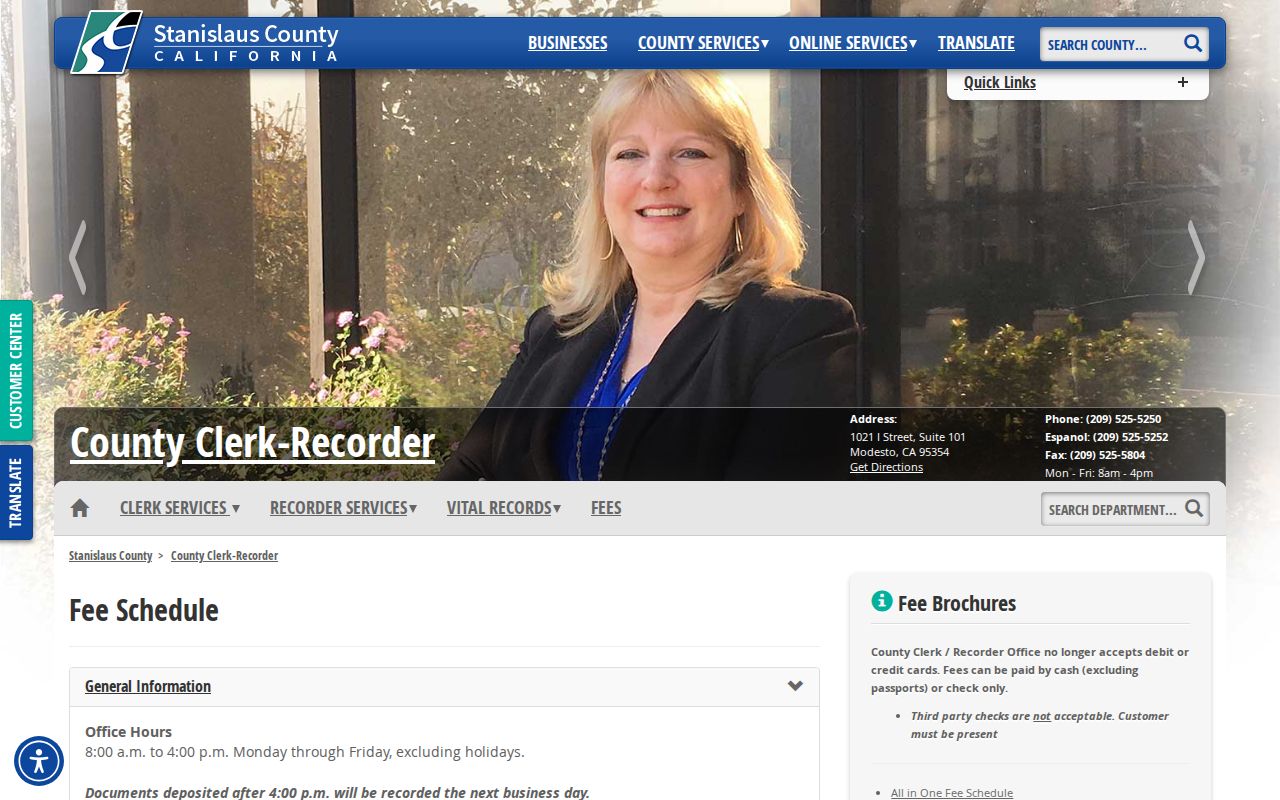
The fee page belongs to the access decision. It does not change the record's evidentiary role, and the live schedule should control any order.
The reviewed schedule lists $6.75 for a first recorded-document page, $3 for each additional page, $2 for certification, and $17 per 15 minutes for document-location research. Older general fee text differs, so confirm the current all-in-one schedule before relying on those figures.
Turlock Film and Fiche Trail
For earlier deeds, the counter route matters. The Stanislaus County Clerk-Recorder is at 1021 I Street, Suite 101, Modesto, California 95354, with a public counter listed for Monday through Friday, 8 a.m. to 4 p.m. The office phone is (209) 525-5250. Use the office's recorded-document guidance to understand whether a locator belongs in the 1920-1988 grantor and grantee terminal, a book and page search, or older film and fiche.
The office guide says computer index and images cover 1978 forward, the dedicated counter index covers 1920-1988, and pre-1978 documents are located by volume, book, and page. Film and fiche reach back to 1853. The numeric fee-book index from about 1894 is another historical path when a name search needs a number or sequence. Ask staff which locator is appropriate instead of requesting a broad profile.
The Stanislaus recorded-document search guidance explains why party roles and instrument types must be read together.
Copies, counter inspection, and film or fiche each answer a different need. A plain image can support a transcription. A certified copy may be needed for a formal matter. A counter search can locate a record without proving who occupied the property. Earlier previous residents often require this layered counter route.
Note: Index depth and image depth are separate facts, so an old hit may still require a counter or film search.
Turlock Assessment Rolls and Maps
CSU Stanislaus Special Collections gives a house history a local bridge between deeds and household sources. Turlock assessment rolls run from 1908-1954. Turlock maps run from 1903-1972. The maps can reconcile street lines, block numbers, parcel changes, and boundaries, while the rolls can name a taxpayer or connect property to a year. Both sources should be read as evidence of their own kind.
The parent county and cities collection spans county history from 1854 to roughly the 1980s and is open for research. It includes Turlock personal-property lists from 1934-35, 1939-40, and 1954-55. Contact Special Collections at the University Library, One University Circle, Turlock, CA 95382, or mweppler@csustan.edu with a date, name, street, APN, or collection description. Ask which box or folder can be requested.
Assessment evidence may identify a taxpayer who owned property elsewhere, while a map can show a structure without naming anyone. The distinction is central to house-history research. Keep a source log with the label owner, taxpayer, directory householder, census resident, permit participant, or occupant evidence.
Turlock Households Across Census Years
Ownership becomes a household history only after directories and census schedules are paired with the parcel trail. The 1913 Turlock census is a rare local bridge between federal schedules. Federal population census records are public through 1950 under the 72-year rule. Printed city directory years are not fully established, so ask the Stanislaus County Library for Turlock, Modesto and Turlock, Stanislaus County, telephone, and criss-cross variants. The Turlock city directory collections page keeps the shelf and entry-format questions separate from the backward address chain.
- Fix the old place with the APN, legal description, map series, and the closest known street form.
- Choose the nearest directory year and copy the listed name, address, spouse notation, occupation, and any property-status mark exactly.
- Compare that entry with the 1913 local census or the nearest federal census year, noting household relationships and occupation.
- Test the name against the 1908-1954 assessment rolls, personal-property lists, newspaper archive, or a marriage record when the dates fit.
- Use an obituary, probate file, or community record as a possible endpoint, then state what remains uncertain.
The previous residents of one address may appear under a spouse, initial, former surname, spelling variant, or a different street description. A person who disappears from a directory may have moved, died, gone unlisted, or fallen into a missing publication year. Negative findings should say that the person was not located in the searched source and range, not that no record exists.
Sanborn Clues for Turlock Addresses
Sanborn maps help answer whether a structure, use, and numbered lot fit the address being traced. Confirmed Turlock editions are 1888, 1891, 1896, 1905, 1907, 1910, 1912, 1922, and a 1945 updated edition. They show building outlines, materials, uses, street names, property lines, and house or block numbers. They do not show occupants, so a map match cannot name an earlier occupant.
Turlock's downtown fires in 1893 and 1907 affected much of the built fabric. The fire history does not prove that county deed books or record indexes were destroyed. Use the fire dates as a reason to compare Sanborn sheets, maps, permits, and newspapers, not as an explanation for every missing deed or directory entry.
Building and Planning records can add a project date or address clue. The issued-permit search uses address and APN paths, but an official online cutoff for the individual search was not located. Ask the City of Turlock for an existing permit or planning file by exact address or APN, and treat an applicant, owner, or contractor as a project participant rather than an occupant.
The physical trail is simple: address to APN, APN to map, map to legal description, legal description to deed, then deed to directory, census, and newspaper checks. Each step should retain its own source and date.
Turlock Previous Residents and Lawful Use
House history is strongest when it serves genealogy, preservation, family memory, an estate question, or a careful attempt to understand a building's past. Obituaries, probate notices, yearbooks, local newspapers, and community archives can close a household trail after the deed and census work is done. Turlock Journal microfilm is in the CSU stacks; digitization from 1904-2008 was coordinated through the California Digital Newspaper Collection, Newspapers.com, the Turlock Historical Society, and Turlock Public Library. Confirm remote access before promising a searchable file.
California's Public Records Act covers existing identifiable records, not a demand that an office create a resident profile. A narrow request can name the address or APN, record series, and date range. Redactions and access limits still apply. The official California Public Records Act text is the source for the statutory framework.
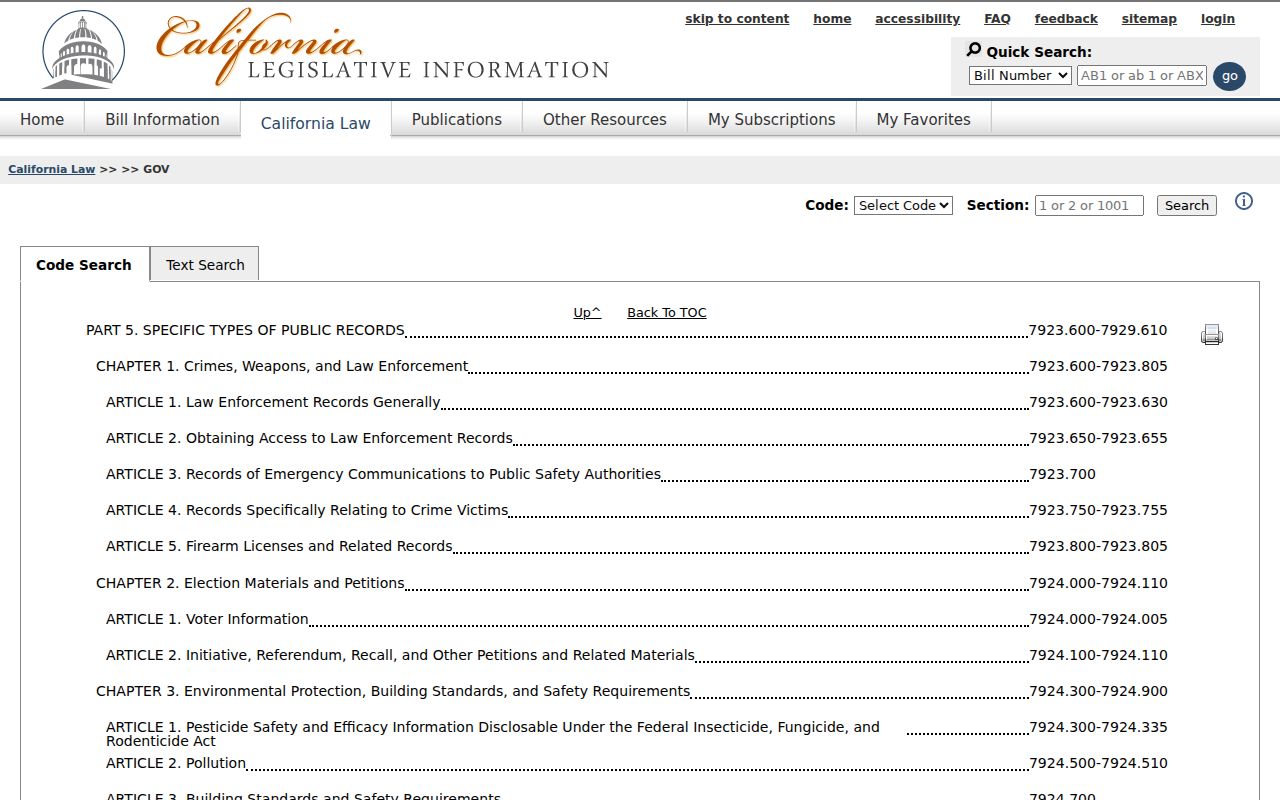
The statute image marks the lawful request channel. It does not turn private household details into a general-purpose roster, and the proper custodian still decides what can be released.
Lawful house history. Use Turlock previous residents records for personal, lawful research such as genealogy or preservation. Do not use an address trail to stalk, harass, threaten, expose, or harm a living person.
When a record appears wrong, ask the custodian for its correction, clarification, or redaction process. Preserve the source date and the office response. A compiled lead can suggest the next archive, but the source record and its role must support the conclusion.
Note: A careful house-history conclusion should identify the source, record role, date, custodian, and remaining uncertainty.