
Turlock Resident Lookup: Match the Question
A useful Turlock resident lookup begins by deciding what must be confirmed. A parcel can identify an owner and a tax mailing destination, but it does not list every person at a home. A court index can show a party and case status, but a matching name is not identity proof. Vital records concern a specific event and have requester rules. The table below keeps those distinctions visible before a search starts.
| Record | What It Confirms | Where | Access |
|---|---|---|---|
| Assessor parcel | Named owner, tax mailing destination, situs and APN | Stanislaus County Assessor and GIS | Free APN inquiry; owner is not occupancy |
| Recorded document | Named parties and transaction chronology | RecorderWorks or Clerk-Recorder counter | Free index; copies are paid |
| Voter status | A person's own registration status and district information | California My Voter Status | Authenticated self-lookup only |
| Court index | Party role, case number, date, category and status | Stanislaus Superior Court Smart Search | Public case classes; files and images vary |
| Vital index or certificate | Birth, death, marriage or divorce event facts | County Clerk-Recorder, CDPH or historical indexes | Eligibility and product rules apply |
| Business or license filing | Entity, registrant or professional affiliation | SOS bizfile, county FBN and DCA | Public index; not residence proof |
Choose the narrowest source that answers the question. If you know an address, begin with the parcel and recorded-document trail. If you need a person's own election status, use the authenticated state form. If the question concerns a birth, death, or marriage, identify the event and requester category before paying for a copy. If the only clue is a name, search variants and gather a second, independent anchor before treating any result as the right person.
Note: A careful resident lookup is strongest when two independent records share a dated, non-sensitive anchor.
Separate Namesakes in Turlock Records
Common names create the first serious error in a name search. Begin with the strongest fact already in hand: a full name with an approximate age, a former address, an APN, a business connection, or a case number. Search the exact spelling first, then repeat with a middle initial, a former or married name, a hyphenated or compound surname, and a spelling variant. For a business filing, test the entity name and the person name separately.
Next, compare the result across two independent records that share a non-sensitive anchor. A deed party and a court party may share a date and an overlapping location, but neither source should be stretched beyond what it actually says. A registered agent may use a business address. A deed grantor may have moved. An obituary may describe a namesake. Dates, party roles, legal descriptions, and record type carry more weight than a name match alone.
That discipline keeps a resident lookup from turning a shared surname into a false match.
Keep an evidence log with the searched spelling, source, date range, result, and reason for keeping or rejecting it. A negative result should be stated narrowly: the person was not located in the source and range searched. It should not be rewritten as proof that no record exists, because a missing directory year, a sealed case, a restricted certificate, or a different indexed spelling can change the result.
Stanislaus Smart Search: Turlock Court Index
Turlock cases are filed in the Superior Court of California, County of Stanislaus. The local online case index and Smart Search page is the starting point, while the clerk remains the custodian of the actual docket and file. Search by exact party name, then repeat with the variants that matter. A party hit should be checked against its case number, filing date, role, case category, and courthouse before it is connected to a person.
A resident lookup that reaches a court record should preserve the distinction between a searchable party entry and the file held by the clerk.
The local interface is shown in the Stanislaus Superior Court case-search portal. This source image illustrates the court entry point used when verifying a Turlock name, while the live vendor interface can change.
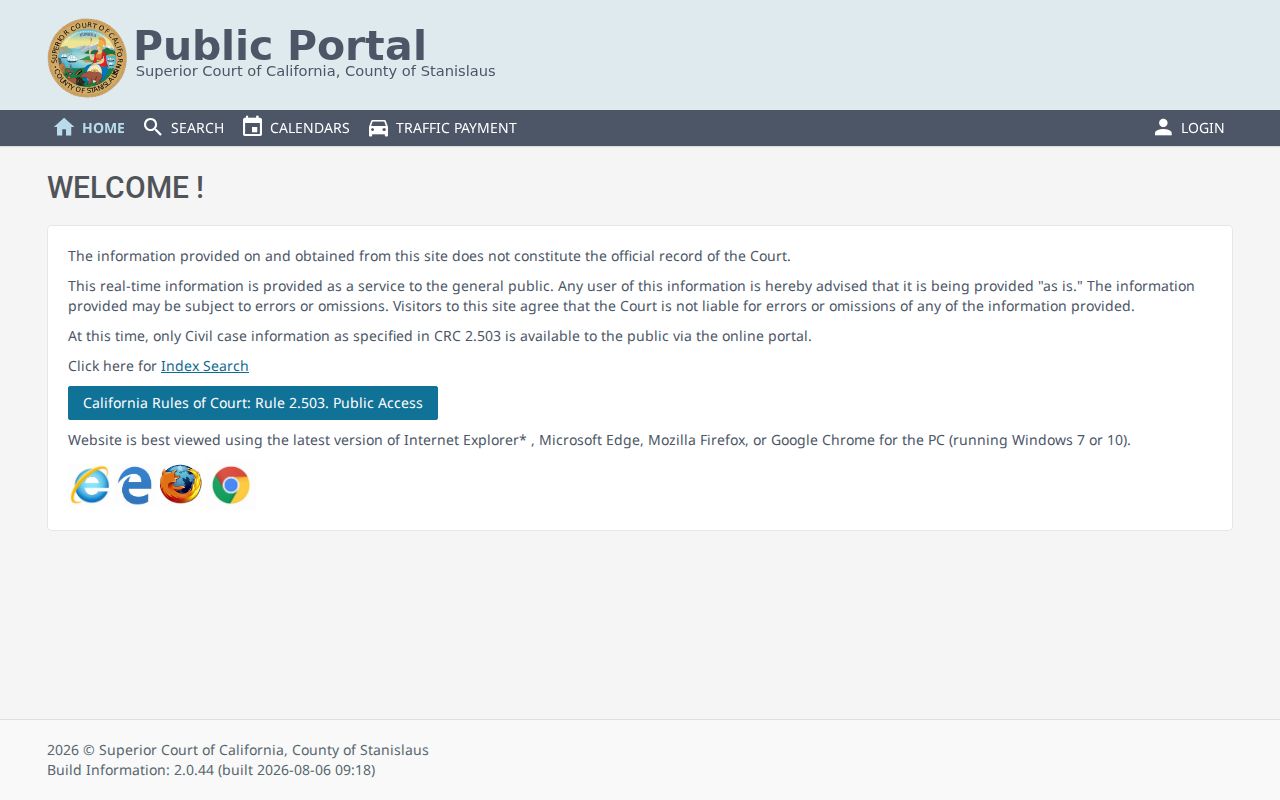
The portal is best treated as an index lead. Capture the exact case number and division, then ask the clerk whether the file is onsite or archived and whether a register of actions is enough for the question.
| Smart Search Field | How to Use It | What It Helps Separate |
|---|---|---|
| Search type | Choose case number or party/name search | Exact case retrieval versus name discovery |
| Last Name or Business Name | Required for a party search; use the indexed spelling | Person, company, and alternate formats |
| First Name | Optional, useful for a common surname | Namesakes with the same last name |
| Middle Name | Optional discriminator | Similar first and last names |
| Case Number | Required in case-number mode; use the exact format | One known case rather than a name set |
| Date range or case type | Use when the live form offers the filter | Time period and category |
| Search or Clear | Run or reset the query | Whether the displayed result belongs to the current search |
Sample docket inventory. A public result may show the case number, caption, plaintiff or petitioner, defendant or respondent, party roles, case category, filing date, status, events, hearings, disposition, judicial department, and courthouse. Documents and images may not be online. Confidential filings, juvenile matters, adoption matters, sealed records, confidential family-law material, and victim identifiers can be restricted. A court index hit is not a complete file and is not identity proof from a name alone.
Federal matters ordinarily fall in the U.S. District Court for the Eastern District of California. The PACER federal court system is a distinct route for federal parties, cases, and documents, not a substitute for the Stanislaus local index. The source image below shows the federal access point used when a question is truly federal.
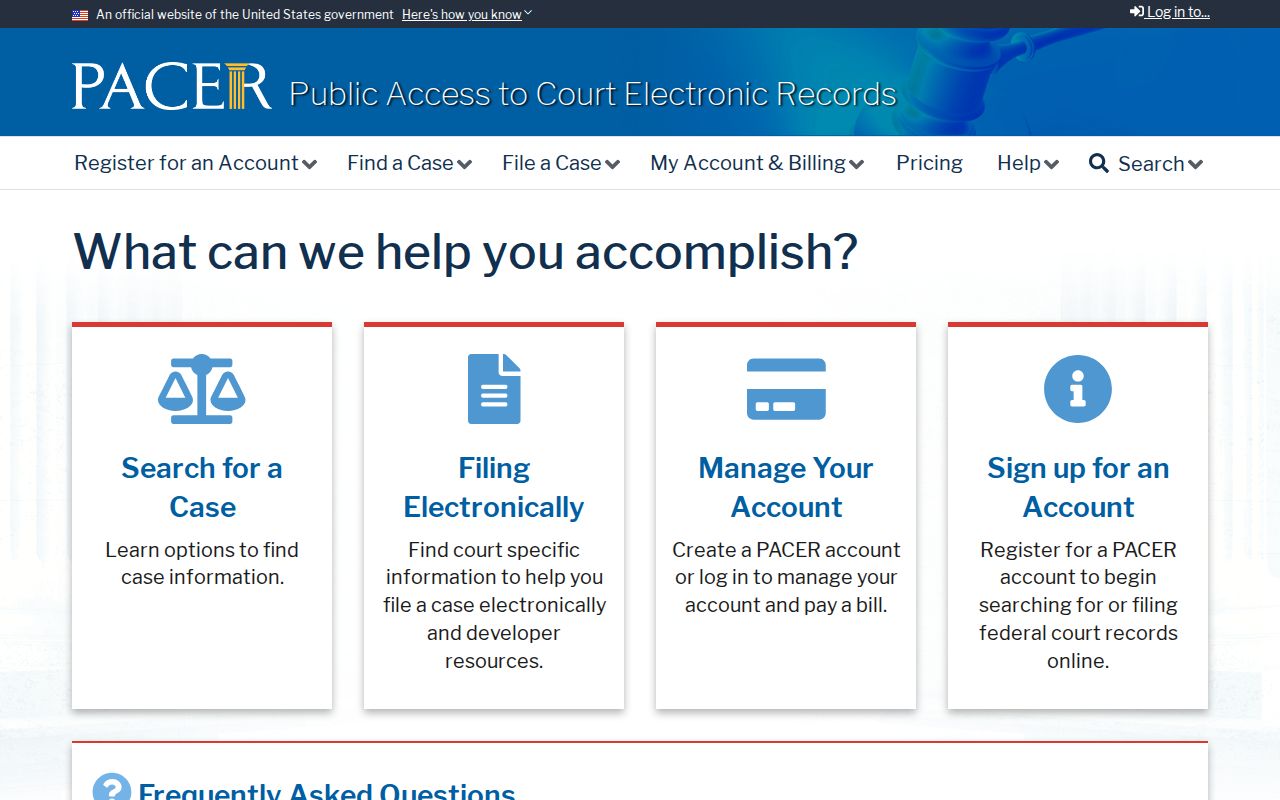
PACER results can place an address or party at a past point in time, and an address may be stale or redacted. Check the court, case type, and filing date before treating it as a useful historical clue.
Note: A docket index can identify a case without exposing the file or proving a namesake is the right person.
Verify One Turlock Resident in Four Passes
The safest verification task is narrow: confirm that a record belongs to the person you have in mind, rather than assembling a broad profile. Work from a known anchor and let each record answer one question. If a source does not add a reliable date, role, place, or event, do not count it as independent corroboration.
- Anchor the name. Normalize the address or parcel when one is known. If the question is voter status, let the person use My Voter Status with the required authentication fields instead of treating voter data as a public name list.
- Run the court party search. Search the exact name and meaningful variants. Record the case number, caption, role, category, filing date, status, events, and courthouse, then set aside any hit that has no matching place or date.
- Confirm the fact type. Use a vital index for an event, a parcel and deed for ownership, or a business or license filing for an affiliation. Compare the date and role, not just the spelling.
- Return to the custodian. Ask the clerk, recorder, assessor, elections office, or issuing board for the narrow index search, plain copy, or certified copy that the question requires. Do not ask an agency to invent a resident profile.
Docket. A court's running register of case events and filings; an online index may show a summary without exposing every document.
Index versus image. An index is a searchable pointer. An image is a scanned document. RecorderWorks advertises a name index from 1850 forward, while electronic images are generally 1978 forward, with a separate 1920 to 1988 counter index and older film or fiche.
Certified copy. A copy the custodian certifies as true to the record held. Certification does not make restricted material public, and it usually costs more than a plain copy.
A small but important Turlock records quirk is the gap between index depth and image depth. A search may reach a historic name entry even when the related image requires a counter terminal, microfilm, or a paid copy request. Record the evidence level each time so a pointer is not presented as the document itself.
Turlock Voter Status Check
California My Voter Status is not a public browser for Turlock names or street addresses. It is an authenticated self-lookup. The form asks for the first name, last name, and date of birth, then requires a California driver's license or identification number, or the last four digits of the Social Security number, according to the person's record and the form's instructions.
| Field | Role in the Form | Privacy Boundary |
|---|---|---|
| First name and last name | Match the registration record | Not a public search by another person's name |
| Date of birth | Personal authentication | Required before status is returned |
| California DL or ID | Identity check when available | Not released as public voter data |
| Last four of SSN | Alternate identity check when needed | Only the permitted file fields are available |
| Continue or Submit | Retrieves the person's own status | Recent online registrations may take at least 24 hours to appear |
A returned self-service result can include registration status, political-party preference, language preference, polling place, upcoming election information, vote-by-mail or provisional-ballot status, guide-delivery preference, and a county contact. Elections Code §2194 restricts voter-file access to approved election, scholarly, journalistic, political, or governmental purposes, and 2 CCR §§19001 to 19013 address applications, security, and permitted use. Driver-license or identification numbers, Social Security numbers, and signatures are withheld.
Safe at Home participants use confidential voter registration and should rely on the program rather than expose a residential address through an ordinary workflow. For a historical question, CSU Stanislaus Special Collections holds Great Register cancellations from 1878, but historic elector evidence shows participation or registration context, not ballot choices and not a current address.
Turlock Vital Records Have Separate Access Rules
The Stanislaus County Clerk-Recorder maintains births, deaths, and marriages that occurred in the county, while the California Department of Public Health provides statewide certified-copy services. Divorce decrees and case files belong to Superior Court. A vital record is tied to a particular event, so first identify the record type, event place, and requester category instead of assuming a modern certificate is an open name result.
For a resident lookup involving a family event, the certificate type and requester eligibility are as important as the name.
| Record Type | Custodian and Coverage | Eligibility or Product | CDPH 2026 Fee |
|---|---|---|---|
| Birth | County or CDPH; statewide files begin July 1905 | Authorized certified copy with eligible requester and sworn statement, or informational copy marked not valid for identity | $31 |
| Death | County or CDPH; historical indexes can assist | Authorized or informational copy; authorized requests have eligibility rules | $26 |
| Public marriage | County or CDPH; state index coverage is 1905 to 1999, 2001, and 2008 to 2025 | Product and application rules apply; use the county of license for gaps | $19 |
| Confidential marriage | County of issuance | No general public access; parties or a court order under Family Code §509 | Verify county schedule |
| Divorce | Superior Court; CDPH offers a limited certificate service | Obtain the decree from the clerk; confidential portions may be redacted | $18 for CDPH dissolution certificate |
Health and Safety Code §§102430 and 103526 distinguish informational from authorized certified copies. An informational copy can contain basic event information but is marked so it cannot establish identity. Adoption files are confidential under Family Code §9200, so an adoption question belongs with the court and official CDSS adoption-information or consent routes, not an ordinary name search.
An application may ask for the record type, name on the certificate, date and place of the event, parents' names for a birth, spouse details for a marriage, applicant contact information, relationship or eligibility, number of copies, signature, sworn statement, notarization for some mailed authorized requests, payment, and a mailing address. CDPH reports roughly four to six weeks. Effective July 1, 2026, CDPH stopped accepting applications through online third-party vendors, so state mail and county channels are central. There is no simple modern rule that a birth or death certificate becomes an open browser record after a fixed number of years.
Note: An informational certificate is not an authorized certified copy and cannot be used to establish identity.
Turlock Heir and Family Trails
Different human questions call for different records. Probate petitions and notices can identify heirs when the file is public and not sealed, but the court index is only the first step. Capture the case number, ask for the available file, and distinguish a probate relationship from a current address. Obituaries and newspaper archives can add spouses, children, former addresses, organizations, and funeral arrangements, but survivor addresses deserve care and date checking.
A former classmate may be easier to trace through yearbooks, alumni material, and university or community archives than through a current roll. CSU Stanislaus Special Collections preserves local government material, Turlock maps, assessment lists, a 1913 local census, and other records that can bridge a historical name to a place. The Stanislaus County Library reference desk can identify city, telephone, genealogy, and newspaper resources whose shelf-level coverage is not fully posted online.
For the historical shelf itself, the Turlock city directory collections guide keeps directory years, reverse directories, and local archive methods in one place. Adoption and birth-family searches must use California's official court and CDSS information and consent routes because adoption files are confidential. A careful search respects the difference between an archival lead and a living person's private contact information.
Turlock Business and License Clues
California Secretary of State bizfile can show an entity name or number, status, jurisdiction, agent, addresses, and filed statements. A Stanislaus County fictitious business name filing can connect a registrant to a trade name as filed. The California Department of Consumer Affairs license search can show a board or bureau, license type, name or number, status, issue or expiration information, and public discipline where available. These are useful when the clue is a business or professional connection.
Do not convert an agent address, office address, license address, or filing address into a home address. Statements can become stale, a business can use a commercial location, and board coverage differs by occupation. A business owner trail can combine SOS filings, a county FBN statement, and a DCA or other board record, but every source should be labeled as affiliation evidence.
The California State Controller unclaimed-property search is another state name index that may offer a lead tied to a reported city or address fragment. The source image below shows the kind of official index a one-person search may check, not a current residence roster.
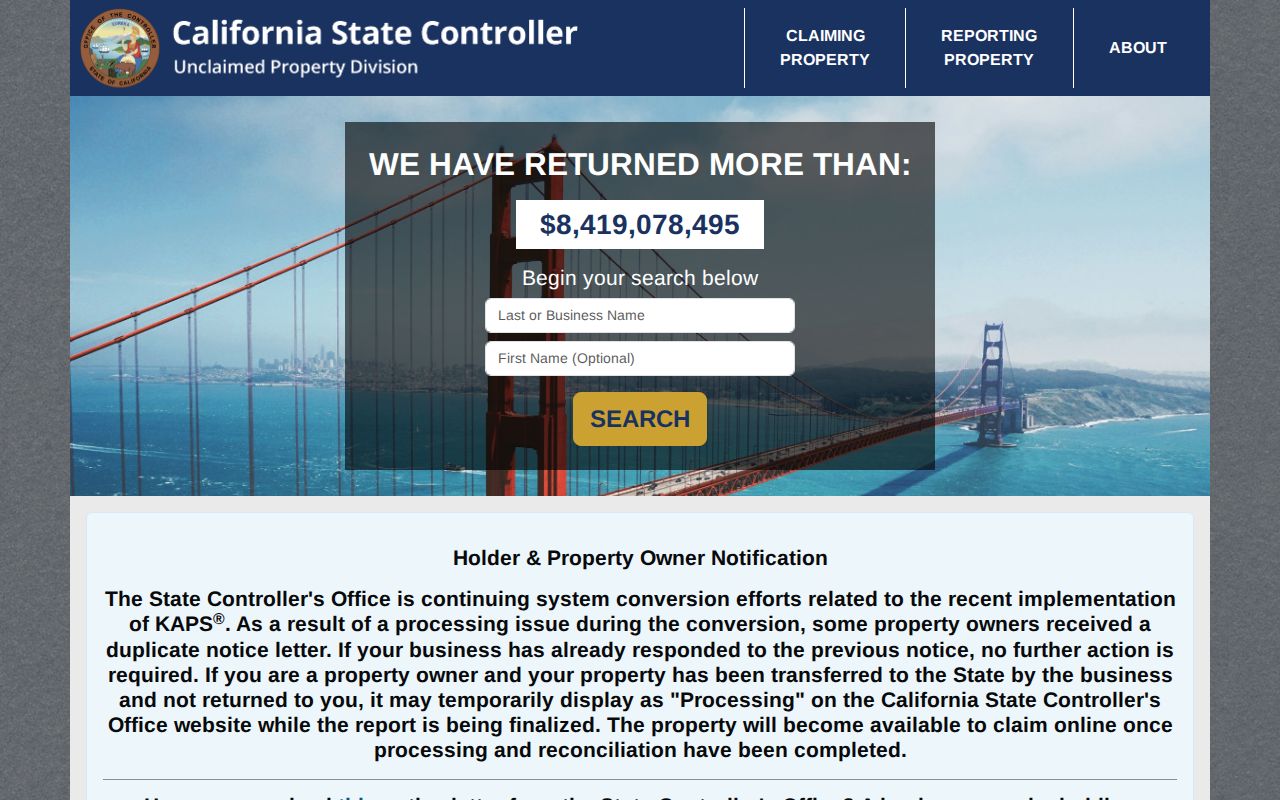
An unclaimed-property match still requires a claim and identity proof. Treat it as a reason to follow the State Controller's process, not as permission to publish a person's address.
Turlock to Modesto: Where Public Records Continue
Turlock is in Stanislaus County, but it is not its own records county. The county seat and principal records counters are in Modesto. The Stanislaus County Clerk-Recorder handles real-property recordings, county births, deaths, marriages, marriage licenses, fictitious business names, and related registrations. Turlock City Hall at 156 S. Broadway holds municipal material such as City Clerk records, council files, permits, planning records, and other city records. Start with the custodian that created the record.
Under the California Public Records Act, Government Code §§7920.000 to 7931.000, any person may request an identifiable record and ordinarily does not need to state a purpose. An agency generally determines within 10 calendar days whether the request seeks disclosable records, with an unusual-circumstances extension of up to 14 days by written notice. That is a determination deadline, not a promise that production will be complete by then. Agencies may recover direct duplication costs and certain statutory costs, and an electronic record may be requested in an electronic format the agency holds. Narrow the date range, department, record type, and names before submitting a request.
Custody tools also have separate jurisdictions. The Stanislaus County Sheriff's Who's in Jail page concerns current local custody. The California Department of Corrections and Rehabilitation locator concerns state correctional custody. The Bureau of Prisons locator concerns federal custody. None is a general residence directory, and custody status, release estimates, or location data can lag or change.
The federal locator is available through the Bureau of Prisons inmate search. This source image is included to show the distinct federal tool that should not be blended with a county court search.
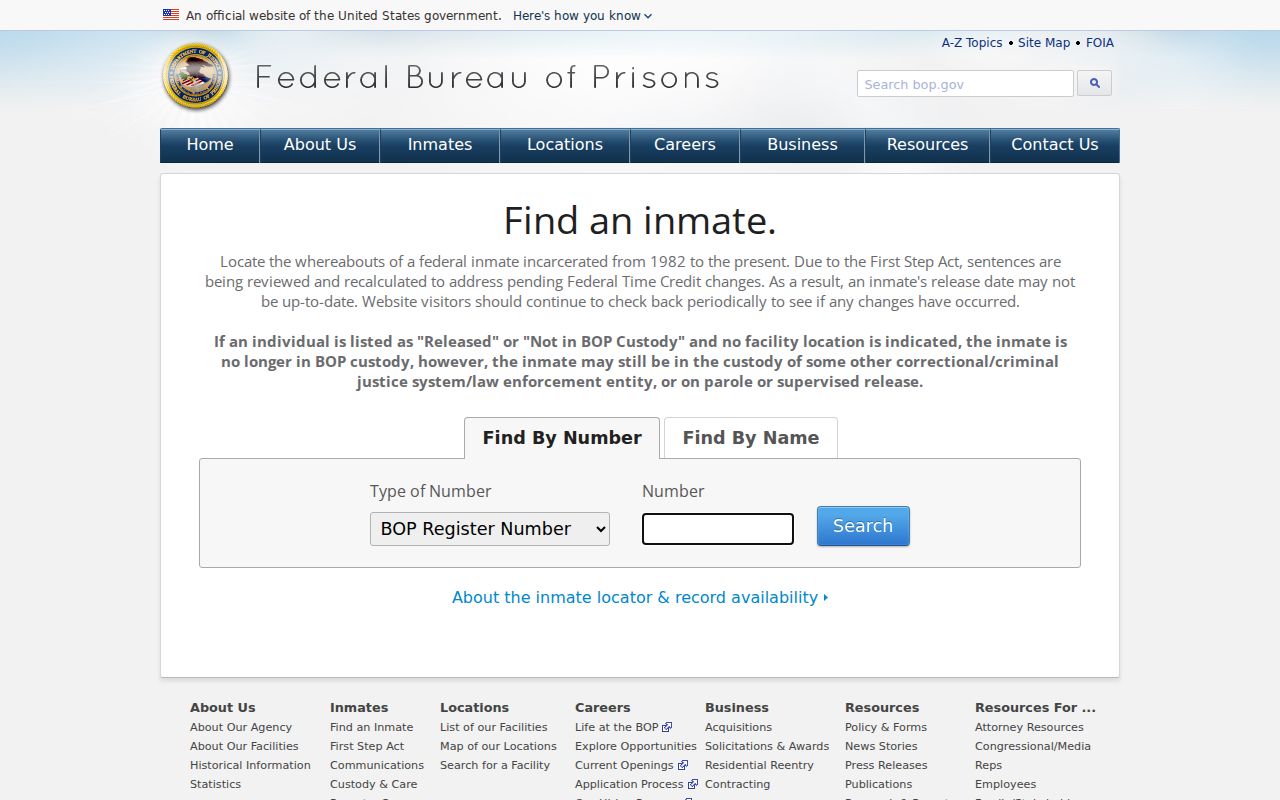
If an online index stops, ask the responsible clerk or records office for a focused search, a plain copy, or a certified copy. The office can explain its procedure, but it should not be expected to confirm that a common-name result is the person you have in mind.
A resident lookup that crosses from Turlock City Hall to a county or federal custodian needs a fresh source note at each step.
Privacy Boundaries for a Turlock Resident Lookup
Public access is not the same as unlimited personal data. California's Safe at Home program supplies a substitute mailing address and can support confidential voter registration for qualifying survivors and threatened participants. DMV information is protected by federal law. Voter driver's-license, Social Security, and signature fields are withheld, and permitted voter-file uses are restricted. Recorded documents can have protected identifiers redacted even when the lawful deed remains public. Utility customer details, delivery information, and many household relationships are not public resident fields.
A compiled commercial record may merge public entries with stale marketing associations and can join the wrong namesake. Use that category only as an unverified lead, then return to the custodian. If an official source is wrong, ask the assessor, Clerk-Recorder, Superior Court, Elections office, or issuing board about its correction or redaction process. A later filing does not erase an earlier index entry that was accurate at the time.
The California Attorney General's Public Records Act overview provides the public-access starting point. It reinforces that a request is directed to a records custodian and a defined record, not to a universal resident list.
Use a careful record search for lawful personal research such as family history, reconnecting, heir work, or civic curiosity. Do not use a record to stalk, harass, intimidate, impersonate, or expose a protected address. When the evidence ends, the responsible answer is that the searched source and range did not establish more.
Lawful use. A Turlock resident lookup is for personal, lawful research and careful source checking. Never use a public record to stalk, harass, intimidate, or harm another person.
Note: A negative result should name the searched custodian and date range rather than claim that no record exists.